

Contracts That Save Business: How Entrepreneurs Can Protect Their Money, Clients and Team
Lawyer Liudmyla Sokolovska on why a verbal agreement is worth exactly as much as the paper it is written on, and which contract clauses can save money, clients and staff.
Translated with AI. Original: Українська
When an entrepreneur launches a beauty salon, a restaurant or a fintech startup, legal subtleties often take a back seat. It seems that everything can be agreed “verbally” or “on Telegram”. However, the first serious conflict with a client, a landlord or a contractor proves that a verbal agreement is worth exactly as much as the paper on which it is written.
Let’s look at how contracts work in practice, why a paper document is not “bureaucracy” but a safety cushion, and which terms will protect your money in the event of force majeure.
1. Why doesn’t “shaking hands” work anymore?
Long ago, back in the days of the Roman Empire, the concept of a contract was built on strict rituals. Today the principle of freedom of contract applies: you have the right to write anything into a contract as long as it does not contradict the law. You can devise a unique form of cooperation that does not even exist in the Civil Code.
But why has written form displaced oral agreements?
- Protection against “amnesia”: In court, words cannot be attached to a case file. A written contract clearly records WHO, WHAT and WHEN was supposed to do something.
- Security of money: A signed document dramatically simplifies debt recovery. If a contractor takes a prepayment for renovating your restaurant and disappears, with a written contract you go to court, while with a verbal agreement you record your losses.
2. Anatomy of a contract: what must be included?
Any contract (civil or commercial) is not just a set of pretty phrases. It has a clear structure.
Important: If a contract lacks essential terms (those without which this particular type of contract cannot exist under the law), the court will recognize such a contract as not concluded. This means it never legally existed, and it will be impossible to compel the other party to perform anything.
The concept of essential terms of a contract is defined in Article 638 of the Civil Code of Ukraine, which provides that a contract is concluded only when the parties have reached agreement in due form on all its essential terms. At the same time, the conclusion, amendment and termination of contracts are covered in an entire Chapter 53 of the Civil Code of Ukraine, which underscores the fundamental importance of properly formalizing contractual relations.
Basic elements that protect your peace of mind:
- Subject of the contract (Essential term No. 1): What exactly is happening? (For example: “The seller transfers ownership of a coffee machine...” or “The contractor provides SMM promotion services for a beauty salon...”). Describe this as precisely as possible.
- Price and payment procedure (Essential term No. 2): How much it costs, when to pay (prepayment, postpayment, in stages) and where (bank details).
- Term of the contract (Essential term No. 3): When the contract begins and when it ends.
3. Top contracts for beauty, HoReCa and retail: choosing the right format
In business, the following contracts are used most often: sale and purchase (purchasing equipment/cosmetics), lease (premises for a salon/restaurant), franchising (scaling a brand) and provision of services. However, there is one trap that “burns” hundreds of entrepreneurs.
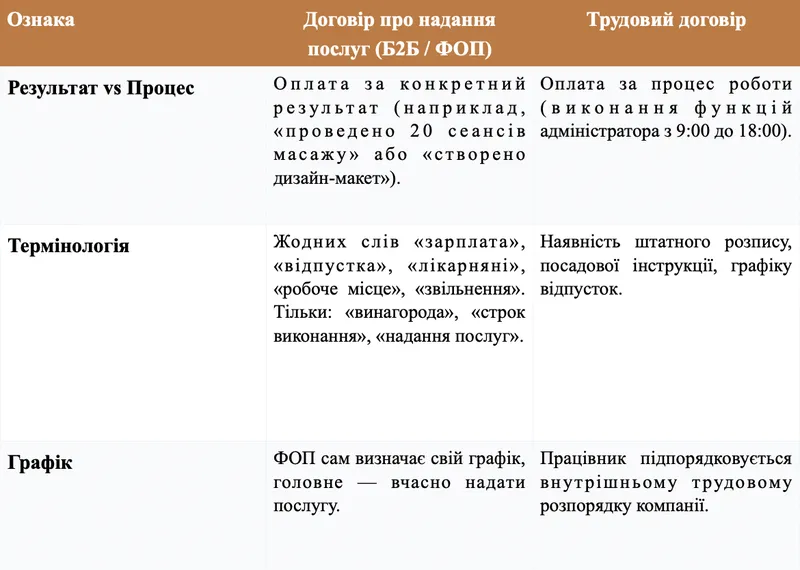
Red zone: Services (B2B) versus employment contracts
Owners of beauty salons and restaurants often register masters, hairdressers or cooks as sole proprietors (FOP) under service contracts in order to optimize taxes. If the tax authority or the State Labor Service finds signs of an employment relationship, the business faces a huge fine for an unregistered employee.
4. When everything goes wrong: force majeure and contract termination
War, blackouts and pandemics have taught business that “circumstances of insurmountable force” (force majeure) are a reality.
- Myth: Force majeure releases you from performing the contract or from paying.
- Reality: Force majeure releases you only from liability for delay (fines, penalties). That is, if a power outage prevents your restaurant from hosting a banquet, you will not pay a fine, but you will still have to return the prepayment to the client.
How to protect yourself? Write a clear procedure into the contract: within how many days a party must notify the other of force majeure (with a certificate from the Chamber of Commerce and Industry) and after what period of continuous force majeure the contract may be terminated unilaterally, without going to court.
5. Legal time bombs: invalidity and nullity of a transaction
Sometimes there is paper, there are signatures, but the contract does not work. Law has two concepts that an entrepreneur should distinguish in order not to lose assets.
- Null and void contract: It is “dead” from the very beginning, by its nature. To declare it invalid, one does not even need to go to court; the law simply does not recognize it.
- Business example: Leasing real estate from a company that is not its owner and has no right to rent it out, or signing a contract by a director whose powers under the Articles of Association have expired.
- Voidable contract: It is considered valid until one of the parties proves otherwise in court (for example, if the contract was signed under pressure or through fraud).
What is bilateral restitution?
If a court declares a contract invalid, the “rewind” rule (bilateral restitution) applies. Each party must return to the other everything it received under the transaction. The buyer returns the goods, the seller returns the money. But if the goods (for example, a batch of cosmetics) have already been used, their value must be compensated in money, which often leads to lengthy court recovery proceedings.
Checklist for an entrepreneur before signing any contract:
- Check authority: Does the director/representative have the right to sign this document (check the Articles of Association or the Unified State Register).
- Remove “employment” wording: If you work with a sole proprietor, make sure the contract does not look like an employment contract.
- Clearly record the money: When, how much and for which specific result you are paying.
- Specify the exit: How you can terminate this contract if the partner stops suiting you.
Remember: A good contract is not written for court. It is written so that the parties clearly understand the rules of the game and the case never reaches court.
Read also: Iryna Halchenko: Ukraine’s Record as a Result of 15 Years of Work in the Construction Industry
Text: Editorial team
Comments
No comments yet — be the first.
Discuss on Telegram