A Day at Hyrox: What Participants Face from Registration to the Finish Line
Hyrox is more than a sporting event. It is a large-scale event with thousands of participants, music, light shows and the atmosphere of a major festival. We explain what a race day looks like and what to be ready for.
Translated with AI. Original: Українська
Imagine a sports arena where thousands of people are present at the same time. Someone is warming up, someone is taking photos by the start arch, someone is nervously checking the laces on their sneakers. Loud music plays, hosts work the crowd, and on giant screens athletes are already visible, covering the final meters of the course.
This is how a Hyrox day begins.
Many newcomers expect to see an ordinary sports hall. In reality, most races take place in large exhibition centers or arenas, where dozens of zones operate at once: registration, warm-up areas, start corridors, spectator stands, sports brand shops, photo zones and a food court.
The first stage is registration. Participants receive a race number and an electronic timing chip. It is the chip that records the result at each stage of the course.
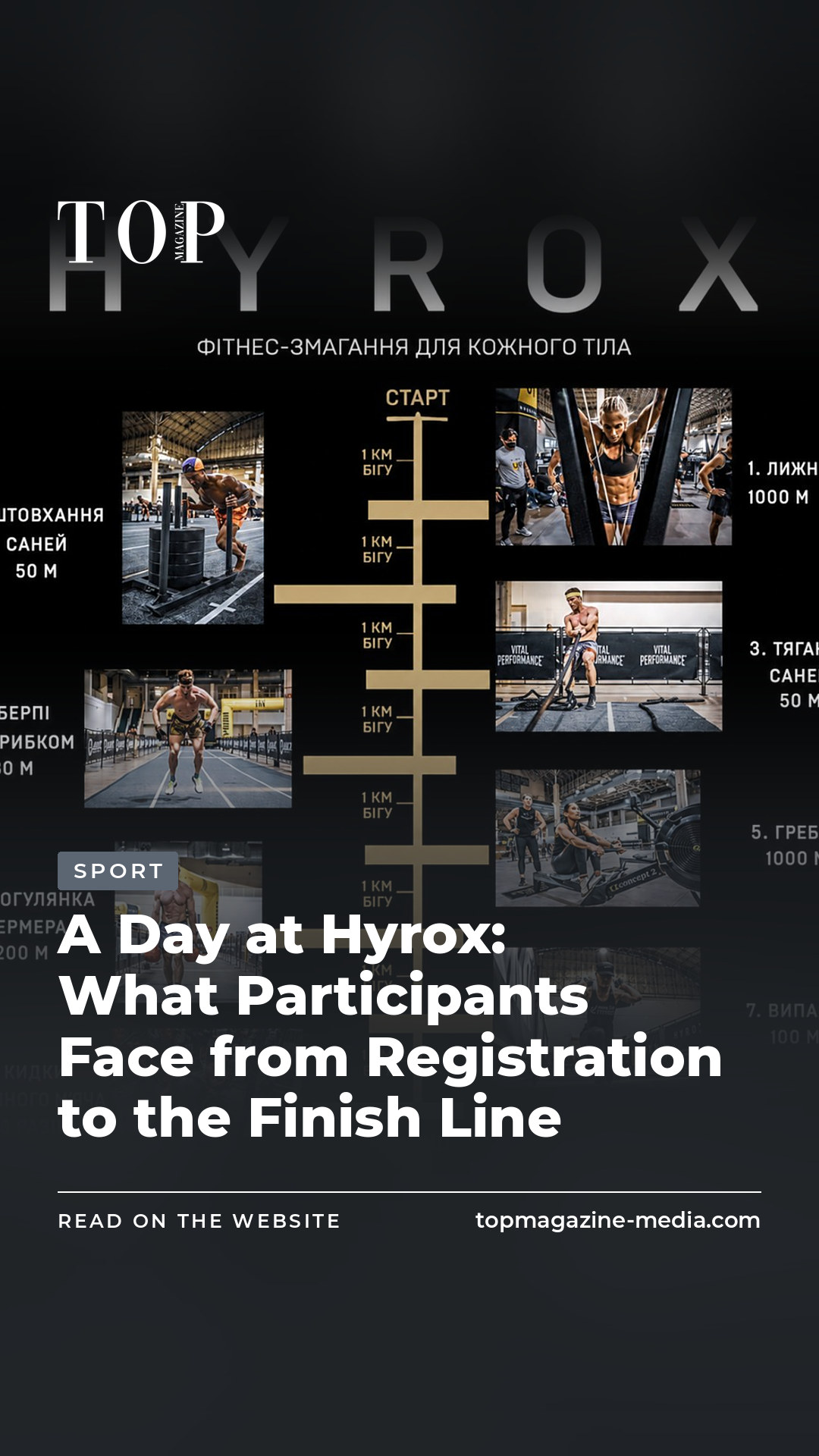
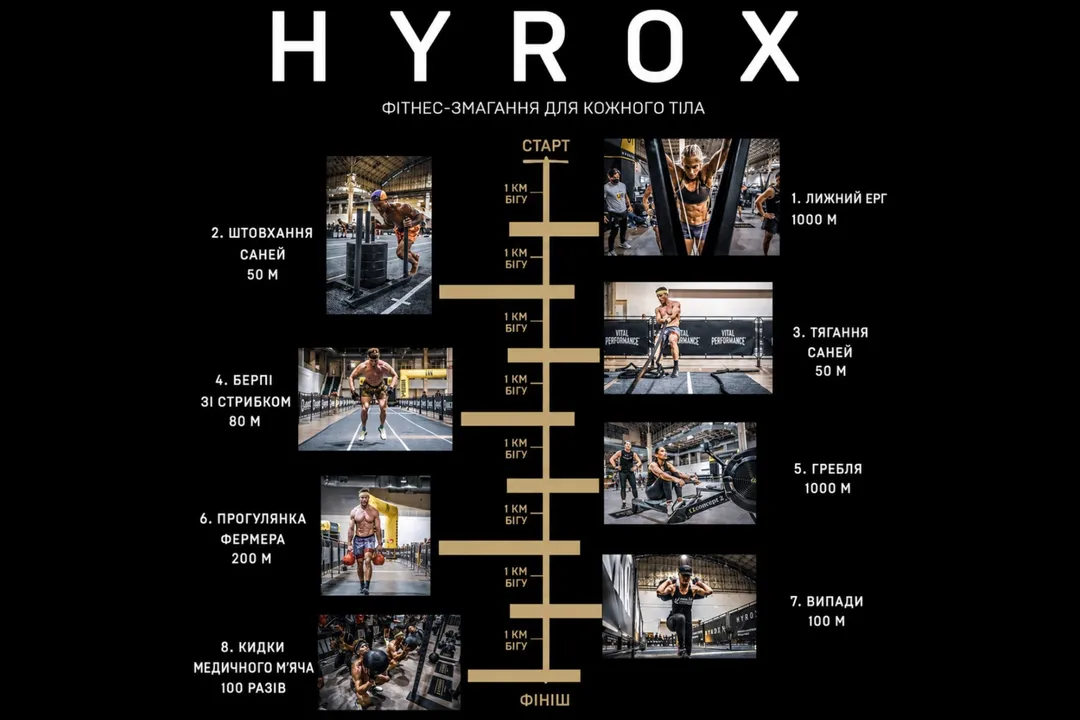
After that, most athletes head out to get familiar with the course. Experienced participants advise walking through the arena before the start. This helps you understand where all eight stations are located and how the route is built between them.
Even before the competition begins, the atmosphere feels more like an international festival than an ordinary sports race. You can hear dozens of languages here, as athletes from different countries travel to the major events. For many, Hyrox becomes a reason to spend a sporting weekend in another city or even another country.
A few minutes before the start, participants are called to the start corridor. They do not go out all at once, but in waves at set intervals. This helps avoid crowding on the course.
After the start signal, the thing everyone came here for begins.
At first, the pace seems comfortable. Many people run the first kilometer even faster than they planned. But after the first exercises it becomes clear: the main opponent here is not the other participants, but your own endurance.
That is why experienced athletes keep repeating one rule:
"Don't win the first kilometer. Try to win the last one."
One of the most emotional parts of Hyrox is the reaction of spectators. At the largest races, the stands are filled with thousands of people. They cheer not only for the professionals, but for every participant who fights until the very end.
It gets especially loud near the last station. People can already see the finish arch, but this is when the body is most exhausted. Most participants remember these final minutes the best.
After crossing the finish line, no one rushes home. Here people pose for photos with their medals, meet friends, relax in lounge areas, buy souvenirs and watch other athletes. For many, this atmosphere is the reason to come back again.
Interestingly, after each race participants receive detailed statistics on their performance. They can see their overall time, running speed, results at individual stations, and compare themselves with other athletes in their age group. That is why many already start planning their next race on the way home.
Hyrox sells not only a sporting result. It sells the feeling of a major event. That is why people are willing to fly across Europe to spend one day in an arena, and then count the months until the next start.
Also read: Preparing for Hyrox? 10 Things to Know Before Your First Race
Text: Arina Blyzniuk
Comments
No comments yet — be the first.
Discuss on Telegram