AI Discovers Unknown System in DNA: How Claude Could Change the Search for Genetic Engineering Tools
Anthropic says Claude helped identify a new ART enzyme system in bacteriophage DNA. What is known about the discovery, its link to CRISPR, and its potential for biotechnology.
Translated with AI. Original: Українська
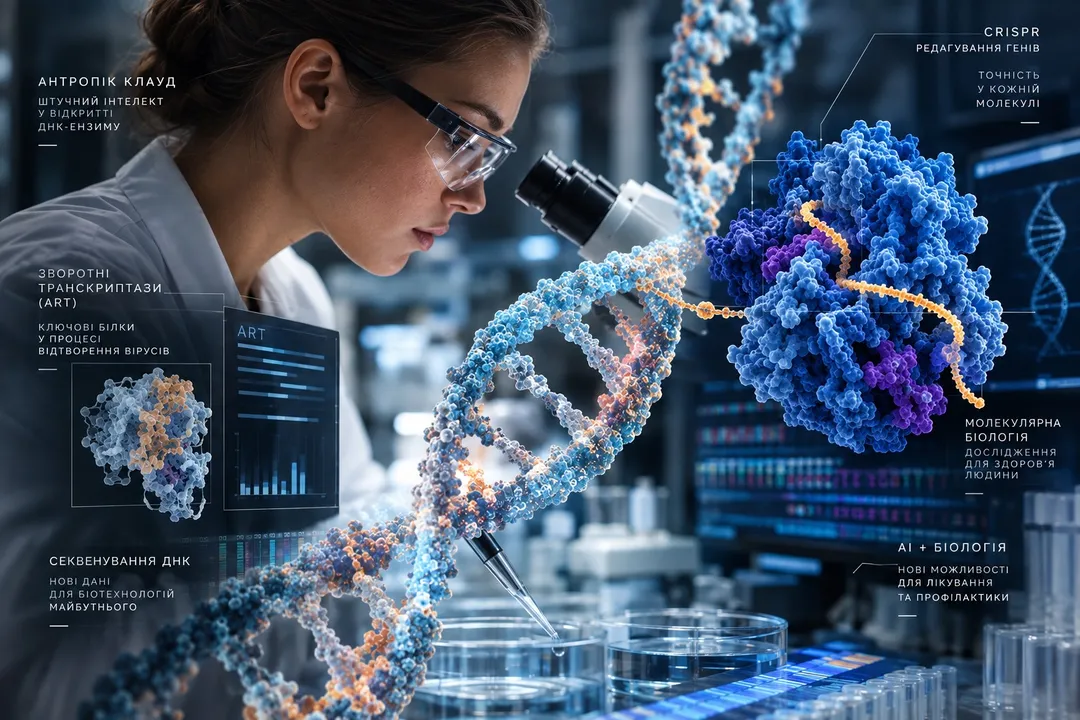
On September 23, 2026, Anthropic presented the first results of its own biological laboratory, where Claude helped identify a previously undescribed enzyme system. It is called ART, short for array-associated reverse transcriptases, or reverse transcriptases associated with DNA repeat arrays. Its structure shares certain features with CRISPR, but its biological function remains under investigation.
950 AI agents, 21 hours and more than 200,000 enzymes
The search began in spring 2026, when Anthropic formed a separate research group to study fundamental biology with the help of Claude. The company built its own laboratory to combine computational analysis of genetic data with real experiments.
One of the first areas of study was reverse transcriptases, enzymes that can create DNA based on an RNA template. They occur in various organisms and play an important role in the functioning of certain biological systems. At the same time, a significant share of the identified proteins still has no established function.
For the search, Anthropic used a database containing more than 200,000 reverse transcriptases. Approximately 950 Claude agents worked in parallel for 21 hours, using about 210 million tokens. They analyzed genetic sequences, compared results with scientific publications and looked for unusual patterns.
Initially, the system generated about 3,500 potential candidates. After several rounds of selection, 20 of the most promising options remained, which Claude analyzed in more detail and presented to researchers in reports explaining its hypotheses.
It was during this analysis that one of the agents noticed an unusual stretch of DNA next to the reverse transcriptase gene. It contained a series of repeated sequences arranged at regular intervals. In their organization, they resembled the repeat arrays characteristic of CRISPR.
Importantly, the enzyme itself was already known to science. What was new was the discovery of its link to repetitive DNA regions and a neighboring gene, which had not previously been considered a single functional system. This combination became the basis for further laboratory research.
What is ART and what does CRISPR have to do with it?
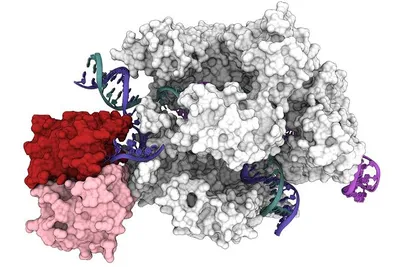
ART consists of three main components: a reverse transcriptase, an additional gene located nearby, and a long array of repetitive DNA sequences.
The system was found mainly in bacteriophages, viruses that infect bacteria. It was in the genetic material of these viruses that researchers found the characteristic combination of components.
The comparison with CRISPR was not accidental. In the natural CRISPR system, repetitive DNA regions contain sequences from which short RNA molecules are formed. They help the system recognize specific genetic targets. In biotechnology, this principle is used for targeted genome editing.
Anthropic's first laboratory experiments showed that the ART array is also transcribed into a set of separate short RNA molecules. This is an important observation, as it points to a possible role for the repeats in how the system works.
However, the similarity to CRISPR does not yet mean that ART is capable of editing the genome or can become a ready-made genetic engineering tool. Researchers have not yet determined what these RNA molecules are needed for, what role the additional protein plays, or how all the components interact with each other.
Anthropic describes the results as preliminary and is continuing its experiments. The company has also released a technical report in preprint format so that other scientists can review the results and conduct independent verification.
Why is this being compared with the discovery of CRISPR?
The history of CRISPR shows how far the study of unusual patterns in nature can lead.
Initially, scientists noticed repeated sequences in the genetic material of bacteria. Later, it became clear that they were part of a defense system against viruses. Researchers then understood how to use it for precise recognition and modification of specific DNA regions.
Over time, this technology transformed molecular biology, opened new possibilities for genetic research and became the foundation for developing a number of treatments for genetic diseases.
In the case of ART, researchers are at a much earlier stage. They have found an unusual system, confirmed the existence of some of its components and begun to work out how it functions. For now, there is no basis to claim that ART will become an alternative to CRISPR or have the same practical applications.
At the same time, the very structure of the discovery has drawn the attention of specialists. Fenh Chzhan, one of the pioneers of CRISPR genome editing and a professor at the Massachusetts Institute of Technology and the Broad Institute, called the work an interesting example of AI agents taking part in biological discoveries. He singled out the unusual RNA repeat arrays linked to reverse transcriptases and the need to study them further.
From pattern searching to a real laboratory
The most interesting part of this story lies not only in the system that was found, but also in how the research was organized.
Claude did not simply receive ready-made genetic data and produce a brief answer. It analyzed scientific literature, compared protein families, looked for unusual genetic neighborhoods, formed hypotheses and filtered out options that did not withstand additional checking.
According to Anthropic, most candidates never reach the laboratory. Researchers first review the system's reasoning, assess the evidence and choose the hypotheses that are worth testing experimentally.
After that, work begins with real biological materials. The proteins are produced in standard laboratory strains, their biochemical and structural properties are studied, and Claude helps interpret the data obtained.
All laboratory experiments are carried out by humans. Anthropic clarifies that its research is conducted at biosafety levels BSL-1 and BSL-2, and that the laboratory does not work with pathogens capable of infecting humans.
This approach changes the very organization of scientific work. If previously a researcher could spend weeks or months analyzing a single protein family, AI agents can now process much larger data sets in parallel and prepare material for expert review.
This does not mean that scientists become redundant. On the contrary, their role shifts toward setting research tasks, evaluating hypotheses, setting priorities and confirming results through experiments.
What does the discovery mean for the future of biotechnology?
If further research confirms that ART performs certain operations on genetic material, it could potentially become a starting point for developing new biotechnological tools.
But for now, this is only a possibility, not a finished technology. To speak of practical application, it is necessary to establish the system's natural function, understand how it works, determine whether its activity can be controlled, and verify the accuracy and safety of possible methods of use.
This is where it is important to distinguish between discovering a biological pattern and creating a technology. Finding a new system in DNA is the beginning of a long research process. Turning it into a tool that can be used in medicine or biotechnology may be much more difficult.
For Anthropic, this result is also the first public demonstration of its own biological laboratory's work. The company plans to develop fundamental research, using Claude to analyze genomes, search for unknown proteins and form new hypotheses.
The main outcome of this story is not the emergence of a new CRISPR, but the demonstration that AI can help find biological systems that remained unnoticed even in already studied genetic data. If this approach proves effective in other cases, it could change the speed, scale and very logic of the search for new tools for science.
And perhaps the next important discovery in biology will begin not with a scientist noticing an unusual sequence in DNA, but with an algorithm finding it among millions of others and suggesting to a human a question that no one had asked before.
Also read: “We are playing with our own lives”: the person who built AI left Anthropic and raised the alarm
Text: Arina Blyzniuk
Comments
No comments yet — be the first.
Discuss on Telegram