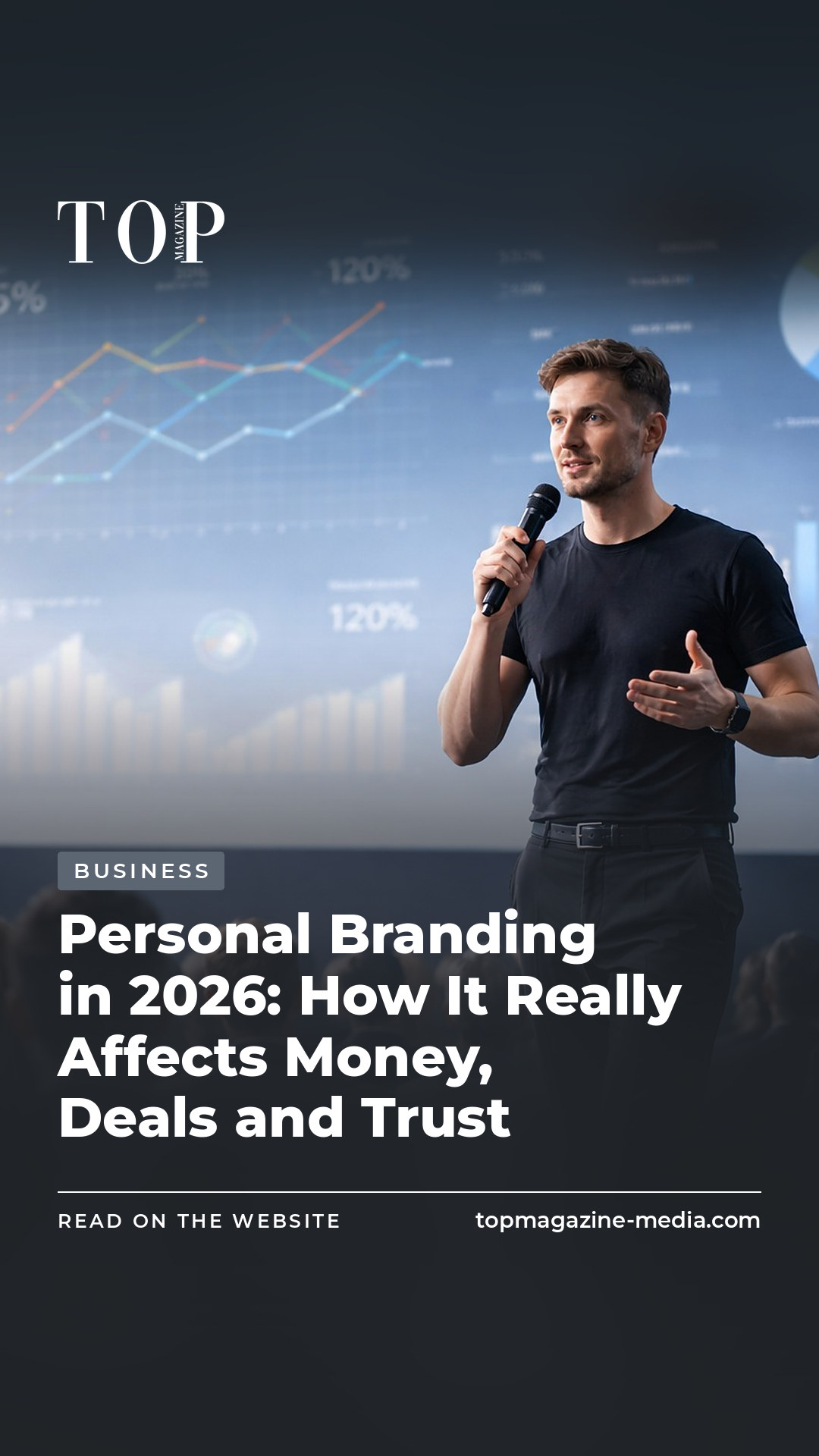
Personal Branding in 2026: How It Really Affects Money, Deals and Trust
Business trend report TOP Magazine
Translated with AI. Original: Українська
Personal branding has stopped being a tool of self-expression. It is now a business asset.
We see this not from motivational speeches but from market decisions: whom people trust, with whom they sign contracts, whom they invite into partnerships — and whom they ignore, even with a large audience.
Today a brand is not about reach.
It is a trust filter through which money passes.

People buy from people — this is no longer a hypothesis
The market has long answered the question of what works better: a faceless business or a living person. Most clients make decisions based not on advertising but on a sense of trust in a specific individual. That is why personal voices consistently deliver better results than corporate accounts.
For businesses, this means something simple: if a company has no clear, visible people, trust builds more slowly and deals become more expensive.
Visibility ≠ conversions
One of the key mistakes of 2024–2025 was chasing reach without business logic. In practice we see:
- large accounts without sales;
- viral content without leads;
- thousands of likes without real clients.
The reason is simple: reach does not equal quality contact.
Business works where:
- there are repeated touchpoints;
- there is dialogue;
- there is a sense of expertise and stability.
That is why in 2026 more and more entrepreneurs deliberately choose smaller but more relevant audiences.
Personal branding as a factor in deals and partnerships
In the B2B environment, personal branding has stopped being a “nice bonus”. It has become part of due diligence.
Before a partnership, investment or major contract:
- people look not only at the numbers;
- they analyze public presence;
- they assess position, language and values.
A weak or chaotic online presence today is read as a risk.
A clear, calm and understandable one is read as a sign of maturity.

Less selling — more deals
The paradox of 2026: the more aggressively a brand sells, the worse it sells.
Audiences quickly tire of direct pressure. Instead, another model consistently works:
- expertise without shouting;
- a position without excuses;
- regular but non-intrusive presence.
Business results today more often come not from launch marathons but from long, consistent communication, where the client matures into a decision on their own.
Personal brand = lower customer acquisition cost
From the standpoint of business metrics, a strong personal brand:
- shortens the sales cycle;
- lowers the cost of a lead;
- raises the average check;
- simplifies repeat sales.
A client who already trusts a person bargains less, decides faster and is less likely to “disappear”.
That is why in 2026 personal brands are no longer built “for looks” and are instead treated as an investment.
Key business laws of personal branding in 2026
1. Trust matters more than popularity
One can be well known and not be convincing. Business chooses the latter.
2. A clear position is stronger than universality
Brands “for everyone” sell worse than brands “for their own”.
3. Depth beats speed
Systematic presence gives more than one-off information spikes.
4. Personal branding is behavior, not content
How a person reacts, stays silent or makes decisions often says more than any post.
5. A strong brand does not explain itself
It is understandable without long descriptions or loud statements.
What this means for entrepreneurs and experts
In 2026 the winners are not those who:
- post more;
- speak louder;
- sell constantly.
Rather, they are those who:
- clearly understand their business role;
- build trust as a person;
- do not lower the bar for the sake of quick reach.
Personal branding is no longer about self-realization. It is about business sustainability.

The market is growing up, and personal branding is growing up with it. It is part of a business's financial architecture. Those who realize this today will spend less tomorrow and earn more steadily.
The material was prepared by the TOP Magazine editorial team as an author's analytical review of business trends in personal branding. The text is based on editorial observations and generalized data from open research and contains no borrowings from other publications.
Read also: January 2026: Working in the Red – the New Norm of This Winter
Text: Editorial team
Comments
No comments yet — be the first.
Discuss on Telegram