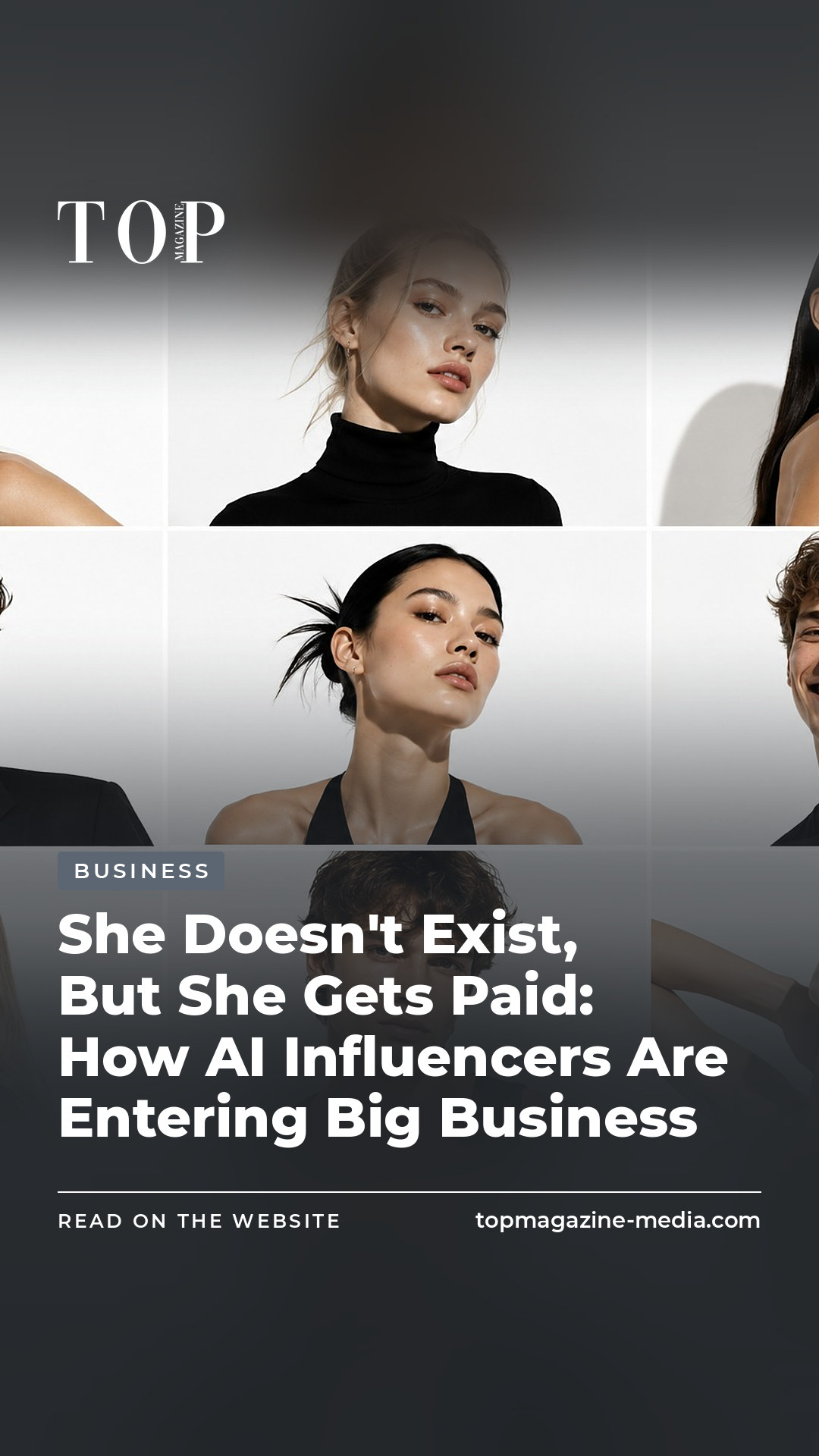
She Doesn't Exist, But She Gets Paid: How AI Influencers Are Entering Big Business
Virtual models are already promoting products, building audiences and landing advertising contracts. Why are brands choosing people who don't exist, and are consumers ready to trust them?
Translated with AI. Original: Українська
A few years ago, becoming an influencer meant creating content, building an audience, negotiating with brands and spending years building a personal reputation. In 2026, it no longer necessarily requires being a human being.
AI influencers — digital characters created with generative technologies — are moving from the realm of experimentation into a real advertising business. They have their own faces, personalities, social media pages and even invented biographies. At the same time, real teams stand behind them, producing content, managing accounts and negotiating with brands.
The main reason for business interest is highly pragmatic: a virtual influencer doesn't need to be sent on vacation, filmed on location or paid for dozens of shooting days. Their appearance can be changed in a few minutes, a new campaign can be created in a day, and content can be scaled with virtually no physical limitations.
According to WIRED, the global virtual influencers market could grow from roughly $14.5 billion to more than $110 billion by 2033. For brands, this is no longer a futuristic novelty, but a potentially huge advertising segment.
But along with the money comes a problem the industry has long postponed: what happens to trust when the person in an ad never actually existed?
In June 2026, The Guardian conducted an investigation showing that some companies are already using AI characters to promote products in ways audiences may not understand: what they see is neither a real customer nor a real influencer. Cases in which synthetic characters created the impression of genuine user experience proved especially controversial.
This is where a new struggle begins — over people's right to know who exactly is speaking to them in an ad.
Europe has already begun setting rules. From 2 August 2026, the transparency provisions of the EU AI Act began to apply: AI-generated content must be labeled in a way that allows its origin to be identified, and deepfake content must disclose that it was artificially created or manipulated.
Tellingly, major AI companies are already adapting to the new reality right now. Anthropic has announced that Claude will use invisible machine-readable watermarks for AI text and provenance metadata for images, explaining it by the need to meet new European requirements.
For the advertising industry, this means a serious shift. Previously, it was enough for a brand to find an attractive person with the right audience. Now the question of where the content itself comes from is becoming increasingly important.
And the paradox is that an AI influencer may prove even safer for a brand than a real celebrity. It won't get caught up in a nightclub scandal, make an ill-advised statement on a live broadcast or wake up one morning to find millions of followers who have decided they no longer support it. A virtual character is fully controlled by the company.
But this very controllability may become its weak spot.
People follow influencers not only for beautiful photos. They follow their lives, mistakes, relationships, travels, tastes and changes. Human unpredictability is part of the product. AI can create a perfect face, a perfect apartment and a perfect wardrobe, but it cannot live a real life in a person's place.
So in the coming years, the question will not be whether AI will replace influencers. It has already created a separate market segment. The question is something else: can audiences build an emotional connection with a character they can never meet on the street?
Perhaps the future of advertising will look paradoxical: brands will have real ambassadors and digital characters at the same time, and their main competitive advantage will be not ideal appearance, but transparency.
Text: Arina Blyzniuk
Comments
No comments yet — be the first.
Discuss on Telegram