673 Diamonds, an Egyptian Queen and a Sledgehammer: Famous Necklace Stolen from Vienna Museum in Broad Daylight
In Vienna, two men smashed a museum display case in broad daylight and stole a platinum necklace with 673 diamonds that once belonged to Egyptian queen Nazli.
Translated with AI. Original: Українська
In Vienna, two men robbed the MAK Museum of Applied Arts in broad daylight, stealing a necklace with 673 diamonds that once belonged to Egyptian queen Nazli. They did not break into the museum at night or try to quietly open a display case. The men simply bought tickets, walked in as ordinary visitors, waited for the right moment and smashed the glass with a sledgehammer.
The robbery took place on August 27 during the exhibition "Glanzstücke", devoted to jewelry by Van Cleef & Arpels. A large-scale display was running at the museum, featuring more than 300 pieces from the French jewelry house and over 200 items from the MAK collection. When the attackers smashed the display case, visitors and museum staff were in the room. No one was injured, after which the men fled with the stolen piece.
What makes this crime especially brazen is that both suspects did not hide their faces. They were captured by surveillance cameras, and Austrian police are now reviewing footage not only from the museum but also from nearby streets and metro stations, trying to determine the escape route. A dog unit has also been brought into the search. According to police, the men are about 170–175 centimeters tall, slim, with dark hair and dark beards.
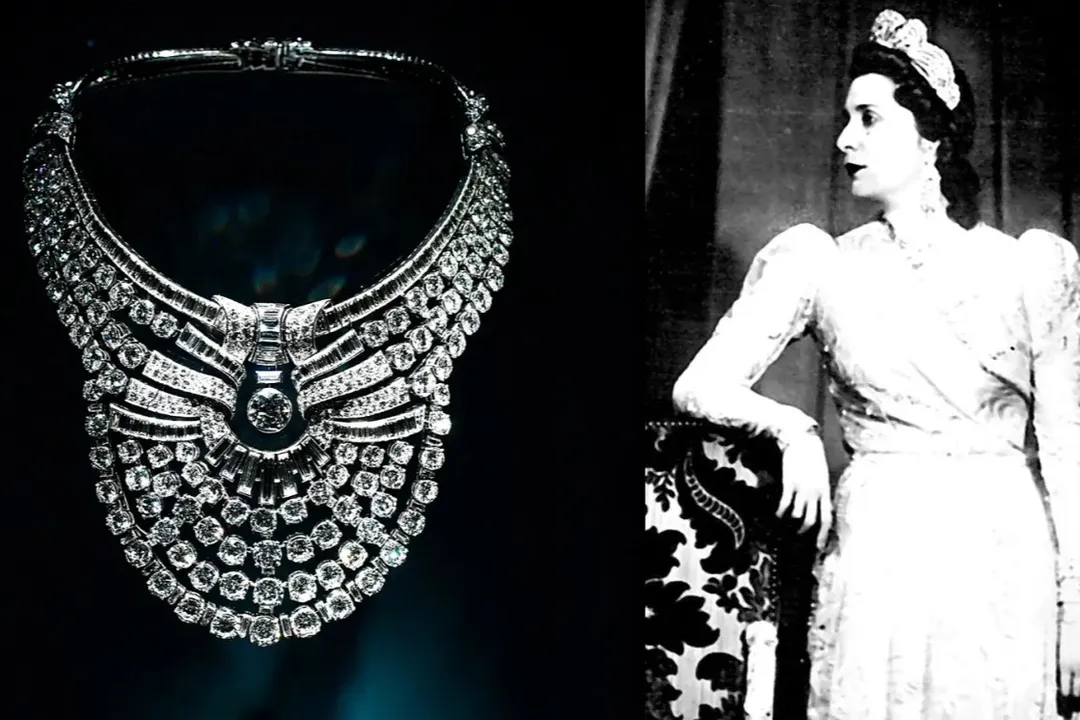
The piece police are now searching for is a platinum necklace with 673 diamonds weighing about 200 carats in total. It was created in 1939 for the Egyptian royal family. The jewelry was made by Van Cleef & Arpels, and the piece was executed in the Art Deco style, with the geometry and radiating arrangement of stones typical of the era.
The necklace also has a history that makes it far more valuable than the diamonds themselves.
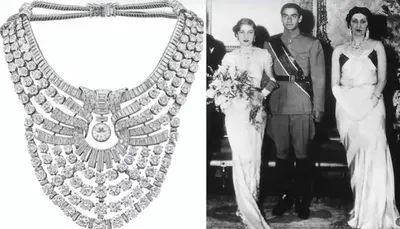
In 1939, Egyptian queen Nazli wore it at the wedding of her daughter Fawzia to Iranian crown prince Mohammad Reza Pahlavi, the future Shah of Iran. That marriage united two influential royal families of the Middle East, and the jewelry set created by Van Cleef & Arpels became part of the history of that ceremony.
Decades later, the piece resurfaced on the market. In 2015, Sotheby’s sold the necklace in New York for $4.3 million, which at the time was about €3.7 million. Police do not disclose its current value, but it is clear that the item carries a multimillion-dollar historical and jewelry value.
The museum is now left with an empty niche where one of the most valuable pieces in the exhibition had been displayed just the day before. MAK confirmed the theft, and the exhibition was temporarily closed to visitors after the incident. The museum later reopened the exhibition space after agreeing on security measures with police.
For European museums, this story is especially alarming also because of when it happened. The Vienna theft became another high-profile case in a series of robberies of cultural institutions across Europe. The most resonant case remains last year's Louvre robbery, where thieves carried off jewelry worth about €88 million, spending only a few minutes on the operation.
In recent months, new cases have emerged in other countries as well. In Spain, a significant part of a Bronze Age gold collection was stolen from a museum in Villena, while in Italy, four Renaissance works by Antonello da Messina disappeared from a museum in Sicily. At the same time, Italian law enforcement recently recovered paintings by Renoir, Cézanne and Matisse that had previously been stolen from another museum.
The Vienna necklace story is especially telling because of its audacity. To steal a piece worth millions of dollars, the criminals did not need a complex plan to get in: they simply became museum visitors.
Now, the 673 diamonds that for more than 80 years were part of royal history have become the subject of an international manhunt. For European museums, this theft is another signal that the era of "untouchable" collections has finally become a thing of the past.
Read also: Cartier, Van Cleef & Arpels or Boucheron: which jewelry the global elite chooses today
Text: Arina Blyzniuk
Comments
No comments yet — be the first.
Discuss on Telegram