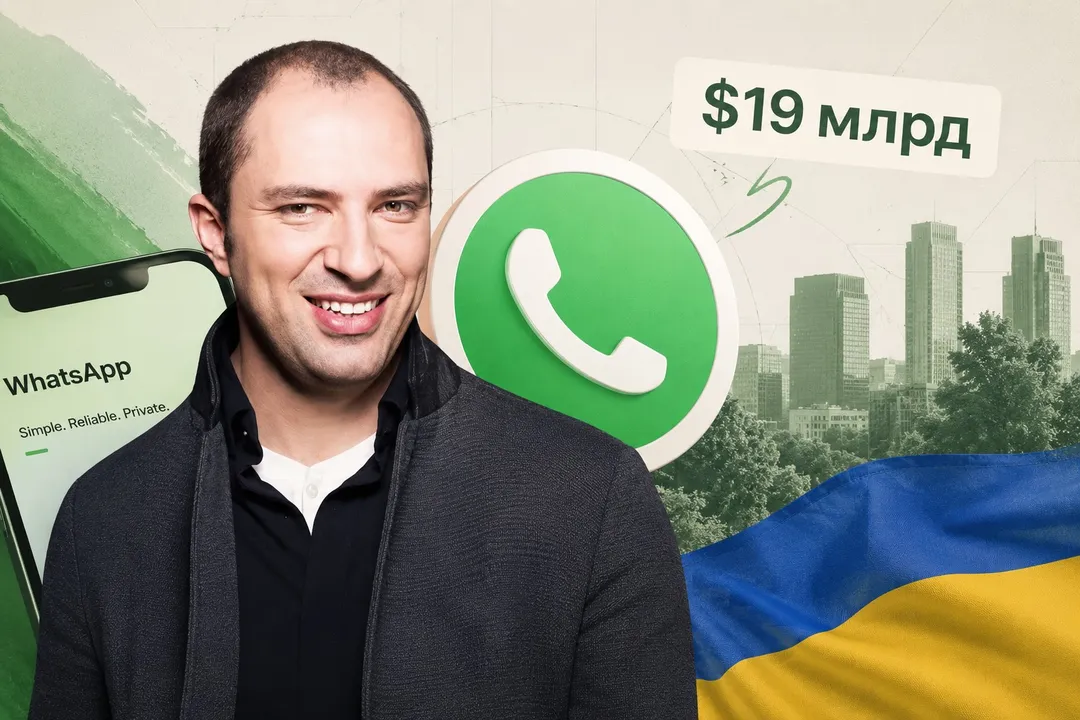
Yan Kum: the Ukrainian who created WhatsApp and sold it for $19 billion
Yan Kum was born in Kyiv, moved to the US at 16, and 17 years later became a co-founder of WhatsApp. In 2014, Facebook acquired the messenger for $19 billion. The story of the Ukrainian who changed global communication.
Translated with AI. Original: Українська
Today WhatsApp is one of the most popular messengers in the world. People use it every day to write to loved ones, run businesses, send documents, photos and voice messages. But behind the story of this global service stands a person who was born in Kyiv and spent his childhood in Fastiv.
His name is Yan Kum. At 16, he moved from Ukraine to the US together with his mother and grandmother. The family settled in California, but the start of their new life was not like the American dream: they lived on a government support program, while Yan worked as a janitor in a grocery store. Years later, he would become a co-founder of WhatsApp, and his company would be valued at $19 billion.
FROM KYIV TO SILICON VALLEY
Kum was born on February 24, 1976 in Kyiv, and spent his childhood in Fastiv. In 1992, when he was 16, he moved with his mother and grandmother to Mountain View, California. At first he knew almost no English, and his computer education was largely self-taught. He later enrolled at San Jose State University, but did not graduate.
His professional path began in cybersecurity. He worked at Ernst & Young, and then joined Yahoo!, where he met Braian Ekton. They worked together for almost ten years, and in 2007 both left Yahoo!. Two years later, this same pair would create WhatsApp.
The idea emerged after Kum bought an iPhone in 2009. Initially he did not plan a messenger, but a simple app showing a person's status. However, after push notifications appeared on the iPhone, it became clear that this system could be turned into a full-fledged mobile messenger.
On February 24, 2009, on his 33rd birthday, Yan Kum registered the company WhatsApp. A few months later, the app began to transform into the service that the whole world knows today.
NO ADS, NO GAMES, NO EXTRA NOISE
WhatsApp was built from the very beginning on a principle that seems almost strange for modern tech business: no ads, no games and no unnecessary features.
Yan wanted the messenger to be as simple as possible: open the app, find a contact and write. A phone number was used for registration, and the contact list effectively became the user's ready-made social network.
Privacy was also important to Kum. Childhood in Soviet Ukraine strongly shaped his attitude toward personal communication and control over information. WhatsApp was positioned from the very beginning as a private way of communicating, not as a platform for collecting as much data about users as possible.
This philosophy became one of the reasons why WhatsApp stood out from many competitors.
450 MILLION USERS AND $19 BILLION
By early 2014, WhatsApp had been growing at an incredible pace.
When Facebook announced the acquisition of the company on February 19, 2014, WhatsApp already had more than 450 million active users monthly. Moreover, the company was adding approximately 1 million new registered users daily. The volume of messages was approaching the global volume of SMS.
A UKRAINIAN TRACE IN GLOBAL IT
In February 2014, Facebook acquired WhatsApp for $19 billion: $4 billion in cash, about $12 billion in shares, and another roughly $3 billion in shares for the founders and employees. At that time, the messenger had more than 450 million active users monthly and was adding about 1 million new users daily.
After the deal, Kum's fortune was estimated at approximately $7.5 billion. In 2018, he left Facebook.
A young man who was born in Kyiv and moved to the US at 16 created one of the most popular messengers on the planet and became a billionaire.
This is the Ukrainian trace in global technology that is easy to miss if you look only at the brand name.
KYIV — FASTIV — CALIFORNIA — YAHOO! — WHATSAPP — $19 BILLION.
Text: Arina Blyzniuk
Comments
No comments yet — be the first.
Discuss on Telegram