Li Krásner and Dzhekson Pollok: The Artistic Partnership That Deserves a Second Look
The Met presents over 120 works by Li Krásner and Dzhekson Pollok. The exhibition explores their artistic partnership, their individual careers and how artists' reputations are shaped.
Translated with AI. Original: Українська
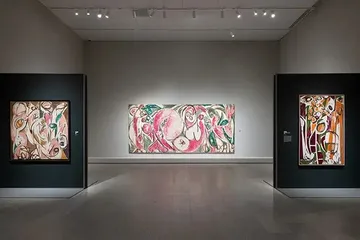
Where does the story of a great artist end and the story of the person who was beside him begin? At New York's The Metropolitan Museum of Art, this question became the basis of the exhibition Krásner and Pollok: Past Continuous, which brings together more than 120 works from more than 80 museum and private collections. The exhibition opened on October 4, 2026, and will run until January 31, 2027. For the first time in more than two decades, the museum has devoted a large-scale project to both artists, showing their careers not separately but in constant dialogue.
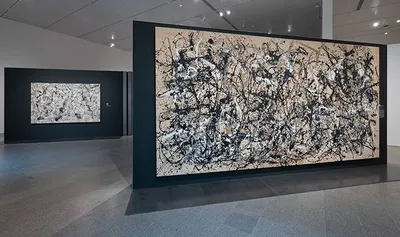
Dzhekson Pollok became one of the most famous representatives of Abstract Expressionism, a movement that changed ideas about what painting could be. His drip painting technique, in which paint was splashed or dripped onto canvas, turned the act of painting itself into an artistic event. Yet alongside Pollok worked Li Krásner, an independent artist with her own vision of abstraction, color and composition. Despite her professional output, in popular culture she remained for decades primarily known as the wife of the famous painter.
Krásner and Pollok met in New York's art scene in the early 1940s and married in 1945. They moved to Springs on Long Island, where they built a life centered on work, experimentation and constant creative exchange. Krásner had her own connections with artists, critics and gallerists, and supported her husband's career. But reducing her role to supporting Pollok means ignoring her own artistic searches, which continued for decades.
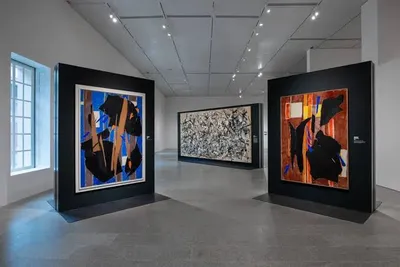
The exhibition shows how different their practices were. Pollok worked with scale, movement and chance, creating canvases that look like frozen gestures. Krásner explored abstraction through dense compositions, saturated color and collages, sometimes cutting up her own earlier works and using fragments of Pollok's canvases. Her Bald Eagle (1955) particularly vividly demonstrates how materials and artistic decisions could move from one creative context to another without erasing the artist's individuality.
After Pollok died in a car accident in 1956, Krásner continued working for almost three more decades. She not only developed her own practice but also looked after her husband's legacy. This circumstance complicates the familiar story of the genius and his companion: Krásner was at once an artist, a critical interlocutor, a partner and a person who helped shape how the next generations would see Pollok's art.
That is why Past Continuous is not simply an exhibition of two famous names. Its chronological structure makes it possible to trace the separate stages of their careers, periods of creative rise and pause, and the way their shared life influenced their art without making it the same. Reconsidering Krásner does not require belittling Pollok: it requires acknowledging that the history of modernism is more complex than the image of the lonely male genius.
Art history is not only a history of works, but also a history of who receives attention, recognition and a place in the canon. When the works of Krásner and Pollok are viewed side by side, one sees not just the influence the two artists had on each other, but also how the museum gaze can change an established narrative, returning to each author his or her own scale.
Read also: Thriller jacket and $800,000 glove: Michael Jackson's iconic looks to be auctioned again
Text: Arina Blyzniuk
Comments
No comments yet — be the first.
Discuss on Telegram