Wellness 2.0: six biohacking technologies changing summer 2026
AI sleep, EMS suits, UV necklaces, wellness patches and red light therapy. Six technologies that this summer are moving biohacking out of labs and into everyday life.
Translated with AI. Original: Українська
Just a few years ago, biohacking was associated mainly with laboratories, expensive clinics and people who tracked every metric of their bodies. In 2026 it is becoming far more accessible. Technologies that once seemed experimental are now turning into everyday wellness devices — they can be worn, used at home and connected to a smartphone.
And the most interesting part is happening right now: AI is starting to work not only with information, but with our bodies, sleep, training and daily habits.
AI THAT WANTS TO PUT YOU TO SLEEP
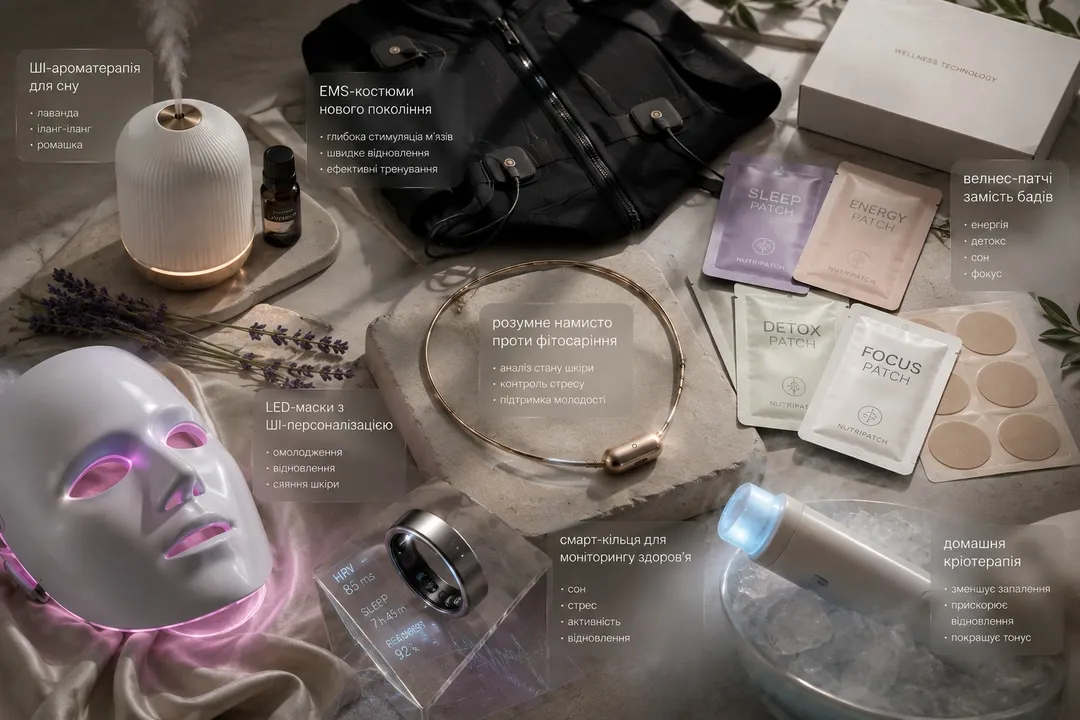
One of the most interesting new categories is personalized aromatherapy for sleep. For example, the Kimba system combines AI, biometric data and controlled scent delivery. It can connect to Oura, WHOOP, Apple Watch and Garmin and adapt aroma scenarios to the user's data. In June 2026, the startup raised $6.5 million to develop this technology.
The idea is simple: instead of just placing a lavender diffuser by the bed, the system tries to make scent a part of a personalized sleep routine.
This is an important shift for the wellness industry: AI is gradually moving from fitness trackers into the environment in which we sleep, train and recover.
AN EMS SUIT INSTEAD OF A TWO-HOUR WORKOUT
Another technology that is developing rapidly is next-generation EMS suits. They use electrical muscle stimulation during training.
New models are becoming lighter, wireless and better integrated with apps. For example, Katalyst claims a full-body workout in about 20 minutes, while modern suits can have more than 20 integrated electrodes for stimulating different muscle groups.
The technology is interesting above all because it tries to solve the main problem of modern fitness — lack of time.
But there is an important nuance: EMS does not turn 20 minutes into a magical replacement for all forms of physical activity. It is a training tool, not a shortcut to an ideal body.
A NECKLACE THAT TRACKS THE SUN
Perhaps the most fashion-friendly novelty of the summer is the smart UV necklace.
In June 2026, The90 introduced Gem, a wearable in the form of a necklace that tracks UVA and UVB exposure in real time and takes into account the wearer's individual skin profile. Instead of an abstract weather forecast, the device shows how much ultraviolet light a specific person is actually receiving.
This is no longer just wellness, but an intersection of beauty + technology + preventive care.
The logic is especially interesting for the skincare market: instead of remembering SPF after the beach, a wearable can remind you about sun exposure while you are still outdoors.
This also shows where the beauty sector is heading: from cosmetics that hide the consequences to technologies that try to prevent them.
A PATCH INSTEAD OF A JAR OF SUPPLEMENTS
Wellness patches have become one of the most visible formats of recent years: magnesium, vitamins, "energy", sleep and other complexes are now sold as small stickers.
It looks perfect for the era of convenience: there is no need to swallow capsules — just apply the patch and forget about it.
But this is exactly where marketing gets ahead of science. Transdermal delivery does work for some medicinal substances, however not every vitamin or active ingredient can effectively penetrate the skin. Experts also point out that there is still insufficient evidence of the effectiveness of many wellness patches.
So patches are a good example of the new wellness market, where a product's convenience does not always mean proven effectiveness.
RED LIGHT LEAVES THE CLINICS
Red light therapy has long since stopped being an exotic procedure. In 2026 it is literally moving into the category of home gadgets: masks, helmets, caps, panels and compact wearable devices.
Moreover, the market is moving not only toward skincare. The latest devices also target hair, recovery after physical exertion and localized use. For example, HigherDOSE presented a red-light hat for the scalp this summer, while the wearable FlexBeam uses red and near-infrared light for muscle work and recovery.
At the same time, the scientific base differs across applications. There is promising data for some dermatological and hair applications, but the effectiveness of a specific device depends on wavelength, dose, design and regularity of use.
AI TRACKERS THAT WANT NOT JUST TO COUNT, BUT TO ADVISE
The last major trend is wearables that are moving from collecting data to interpreting it.
Previously, a smartwatch showed pulse, step count or sleep duration. Now the main question sounds different: "What do I do with this?"
AI is beginning to analyze sleep, activity, body temperature, HRV and other indicators, and to try to turn dozens of numbers into one clear recommendation.
But caution is needed here too: modern consumer wearables can estimate general sleep patterns reasonably well, yet they are not equivalent to medical diagnosis or laboratory research. New studies show that the accuracy of identifying sleep stages from ordinary wearable signals still falls significantly short of full EEG studies.
And this, perhaps, is the main feature of wellness 2026. The industry no longer sells just a cream, a vitamin or a fitness device. It sells personalization.
AI decides which scent to use in the evening. A wearable shows how much UV the skin has received. An EMS suit shortens the workout. Red light therapy moves home. Patches try to replace familiar supplements.
But along with this comes a new rule: the more high-tech a wellness product looks, the more important it is to check what actually stands behind the attractive gadget — clinical data or just very good marketing.
This is exactly where the line runs between the biohacking of the future and wellness that merely pretends to be science.
Read also: Kendall Jenner and $500 million: how K-beauty learned to sell without stars
Text: Arina Blyzniuk
Comments
No comments yet — be the first.
Discuss on Telegram