Perseids 2026: Up to 100 Meteors an Hour — How to See August's Main Meteor Shower
The Perseids will peak on the night of August 12 to 13. This year the shower coincides with the new moon, so the dark sky will create almost ideal conditions for observation.
Translated with AI. Original: Українська
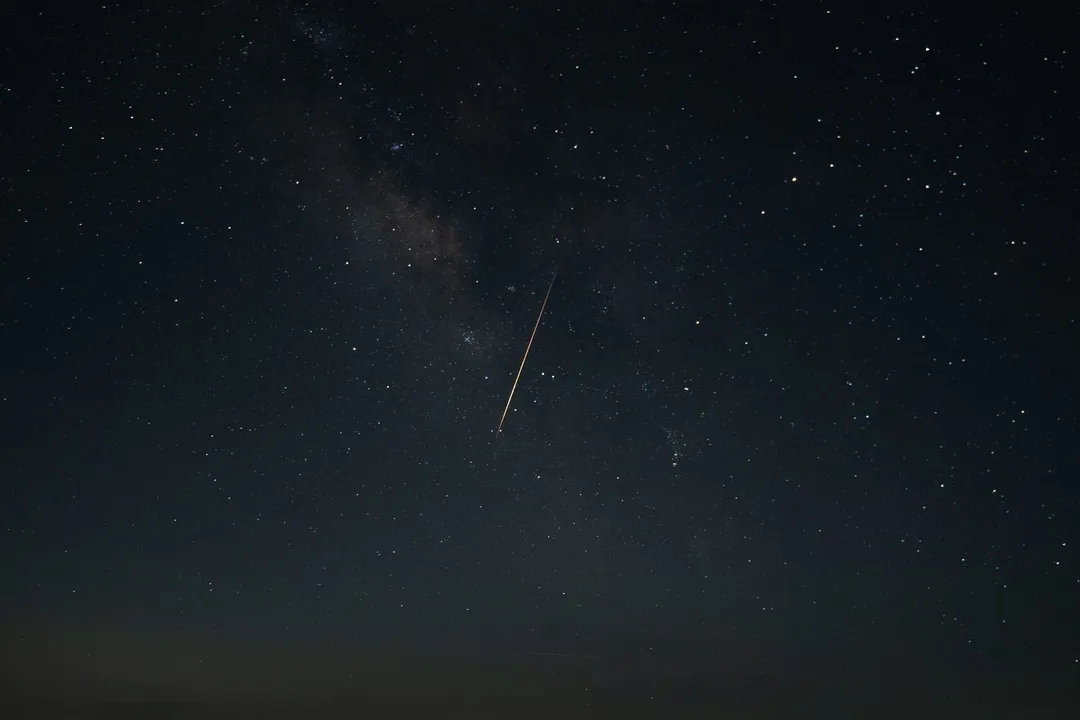
Some nights it is enough to step outside, switch off your phone and look up. The night of August 12 to 13, 2026, is exactly such a night. Earth will pass through the stream of debris from comet 109P/Swift-Tuttle, and in the atmosphere these particles will turn into bright streaks — the Perseids. This year's show is especially notable because its peak coincides with the new moon: the Moon will barely interfere with observations, so the sky will be much darker.
WHAT THE PERSEIDS ARE
In fact, no "falling stars" are raining down on Earth. Meteors are mostly tiny dust particles and debris from the comet, which have remained along its orbit. Comet Swift-Tuttle orbits the Sun roughly once every 130 years and leaves a band of material behind after each pass. Every year Earth crosses this area, and the particles strike the upper layers of the atmosphere at speeds of about 59–60 km/s. They heat up and evaporate, creating brief flashes of light that we call meteors.
The name of the shower comes from the constellation Perseus. That is where the radiant is located — the point from which the meteors seem to emerge. In reality they can appear in any part of the sky, so there is no point in looking only at Perseus. The radiant is needed only to determine which meteor shower a particular streak belongs to.
WHY 2026 DESERVES ATTENTION
The Perseids are active roughly from July 17 to August 24, but the most interesting nights fall in mid-August. In 2026 the maximum is expected on August 13, and the traditional wide window of peak activity covers the night of August 12 to 13. According to the IMO calendar, the theoretical ZHR is about 100 meteors per hour.
But this does not mean that a person in the city will see exactly 100 "falling stars" in one hour. ZHR is calculated for ideal conditions: a dark sky, the radiant high above the horizon, good atmospheric transparency and no light pollution. In reality, the number of meteors seen will be lower.
That is why this year the main bonus is not only the shower's activity but the absence of a bright Moon. The new moon falls on August 12, so moonlight will not "wash out" faint meteors from the sky.
WHEN TO GO OUT AND LOOK
It is best not to rush out right after sunset. The Perseids' radiant climbs higher through the night, and the best hours usually fall after midnight and before dawn. That is when the observer is on the side of Earth that is moving toward the stream of particles.
For Ukraine, the practical guideline is simple: you can go out after 23:00, but the best chances are from about midnight until dawn on August 13. If the sky is clear, it is worth staying out for at least an hour. Meteors do not fall evenly: several may appear almost at once, and then there may be silence for a few minutes.
WHERE TO WATCH
The Perseids' main enemy is not clouds but city lighting. Street lamps, advertising signs and illuminated buildings make the sky bright enough that faint meteors simply get lost.
That is why the best place is outside the city, away from large settlements, with the most open horizon possible. There is no need to travel to a special observatory: a dark field, a lakeshore, a hill or a rural area will already give a much better result.
And here is an important point: a telescope is not needed. For meteors it is even inconvenient, because its field of view is too narrow. The best instrument is your own eyes. Lie down or sit so that you can look at as much of the sky as possible, and give your eyes about 20–30 minutes to adjust to the darkness.
It is better to keep your phone in your pocket. Even a bright screen after a few minutes in the dark will force your eyes to adapt again.
SOMETIMES SOMETHING FALLS FROM THE SKY THAT IS NOT JUST A "STREAK OF LIGHT"
The Perseids are known not only for their number but also for their brightness. Among them there are bolides — especially bright meteors, which can leave a noticeable trail in the sky for several seconds. They are the ones most often responsible for the effect that makes people later say they "saw a real falling star".
And this year there is one more reason not to miss the night sky. On August 12, 2026, two major astronomical events coincide: a solar eclipse will take place during the day, and the peak of the Perseids will occur at night. For most of Ukraine there will be no total phase of the eclipse, but the meteor shower itself will be visible on a clear night.
So if you want to see the Perseids, the plan is simple: a dark place, a clear sky, warm clothing, a comfortable position and a few hours without a phone. Sometimes the best show of August needs neither a ticket nor a telescope — it is enough to simply look up.
Read also: Solar Eclipse of August 12, 2026: What Is Happening to Earth, Nature and People
Text: Arina Blyzniuk
Comments
No comments yet — be the first.
Discuss on Telegram