35 Reasons to Love Ukraine — and That's Far from All of Them
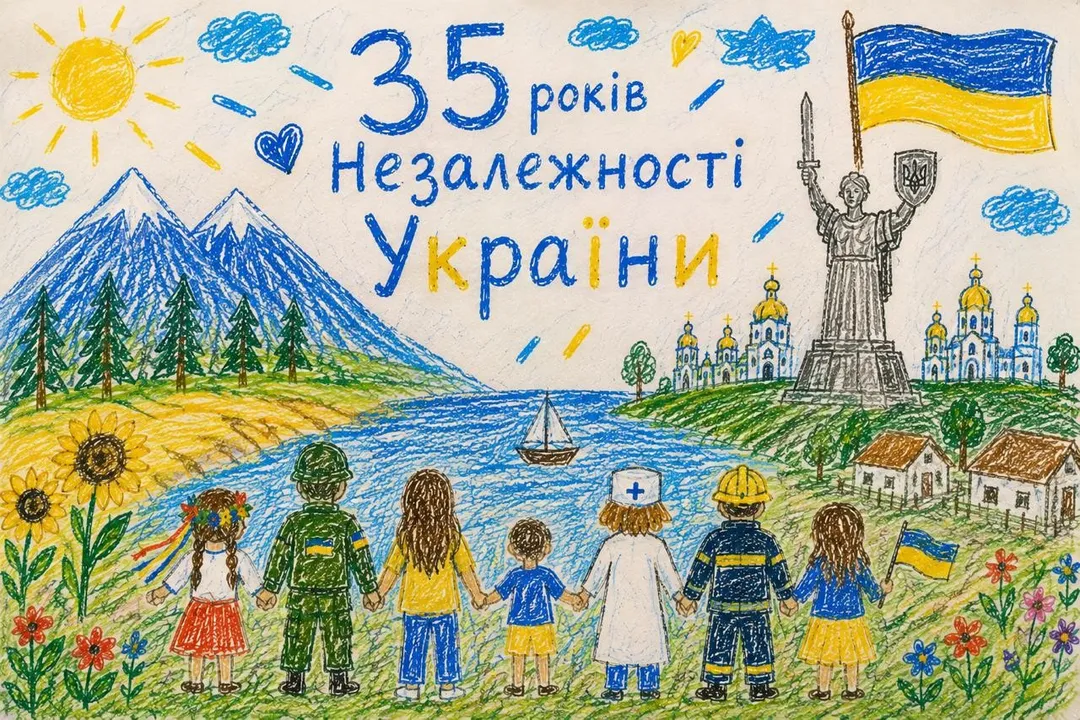
Marking 35 years since the restoration of Independence, this is a story about a Ukraine that cannot be squeezed into a single symbol: its mountains, sea, steppe, art, music, cities, cuisine and people.
Translated with AI. Original: Українська
There is a simple test of how well you know your own country: try to explain it to an outsider in one sentence. Not a slogan, not a date, not a song — one sentence. Usually it doesn't work. Not because words are lacking, but because any single sentence turns out to be untrue through its own incompleteness.
In eight hours of driving you can change the landscape three times here without ever crossing a border. In the morning — mountain pastures, fog and the smell of wet pine. At midday — a steppe as flat as a table, where the eyes have nothing to catch on, and that somehow feels calming. In the evening — the sea, which smells not of resorts but of seaweed and the port. Somewhere in between stand black cones of slag heaps, which no geology ever piled up, and small towns where an old synagogue, a Catholic church and an Orthodox church stand three hundred meters apart, because that was simply how things were built back then.
We have gotten used to it. Habit is the most expensive thing a country pays for being its own. A sunflower field stops being a spectacle when you have driven past it a thousand times. The mosaic on the bus station wall stops being art when you are waiting under it for a minibus. Borscht stops being a cultural phenomenon when it is simply lunch.
And then someone from outside looks at the very same thing and cannot understand why we are so calm. Why we don't take tourists to see a canyon that in another country would be the main postcard. Why we don't explain to the world that the Christmas melody it sings every December was written in Kyiv. Why we don't tell people that part of the cradle of European avant-garde is Kyiv, Kharkiv and Odesa of the 1920s.
This piece is an attempt to look at the familiar as if it were unfamiliar. Thirty-five reasons, each of which exists regardless of dates on the calendar. The list is deliberately incomplete: any other editor would have compiled their own, and would also be right.
1. The People Who Hold the Country Together
Let us start with something that has no landscape. The country rests not on borders and not on symbols, but on the everyday competence of specific people, most of whom will never appear on any list.
Soldiers have learned to fight a stronger adversary and to retrain in the middle of the process — with different equipment, different communications, different tactics than a year ago. This is about courage, and about the ability to think fast. State Emergency Service rescuers enter a building when everyone else is leaving, and they do it by protocol, without fuss — it is composure, not impulse, that here separates a good outcome from a tragedy. Doctors have gained surgical experience over these years, and colleagues from countries where such practice does not exist now come to learn from them.
The volunteer system, which grew from nothing, works like a logistics company: procurement, route, report, confirmation. Power engineers restore substations to standards that no one would have believed in before 2022. Utility workers go out into the streets at six in the morning. Railway workers run freight by timetable, and somehow that timetable is kept.
Alongside them are those who are not shown on the news. A teacher who runs a lesson for a class scattered across three countries and remembers who is in which time zone. A farmer who sows a field mined last year. A woman who opened a café in a town seventy kilometers from the front, because people need a place to sit down. A programmer who is in a client meeting at nine in the morning and at a team gathering at nine in the evening. A craftsman who makes furniture. A mother who puts her children to bed every evening and every morning pretends that everything is fine, and thanks to that, everything really is a little more fine.
The state is an abstraction. It can be felt only in how people behave when things become difficult. Here, they behave well.
2. The Carpathians — Where the Country Changes Its Voice
The mountains here are not the highest: Hoverla — 2,061 meters, and any alpinist would smile indulgently. But the Carpathians are interesting not for their height. This is a rare case where culture grew straight out of the landscape and remains inseparable from it.
The mountain pasture shaped a way of life: seasonal grazing is at once a calendar, music, cuisine and social structure. The trembita, over three meters long, exists because its sound had to travel across kilometers of slopes. Brynza and bundz are the result of milk having to be kept without a refrigerator. Rugs were woven from sheep's wool because it was here, and then felted in a mountain stream. Hutsul fiddle music has a rhythmic structure that jazz musicians take quite seriously.
And the very optics of these places: «Shadows of Forgotten Ancestors» by Sergei Parajanov, shot in 1964 in Hutsulshchyna based on the novella by Kotsiubynsky, still remains one of the most influential films of East European cinema. They did not shoot a set — they shot what was there.
3. Eight Churches Built by Carpenters
In 2013 UNESCO inscribed sixteen wooden churches of the Carpathian region on the World Heritage List — eight of them in Ukraine, eight in Poland.
These buildings were raised not by architects but by village carpenters, without drawings, following a tradition passed from hand to hand. Log construction, wooden helmet-shaped domes, carving, wooden shingles. The oldest of them are older than most stone cathedrals that we are used to considering "serious" architecture. The wood they are made of has stood for four to five hundred years — and, to be honest, that is the best possible review of the quality of the work.
4. Places That Look Like a Mistake in Geography
The Dniester Canyon is one of the longest canyons in Europe, with about two hundred and fifty kilometers of bends between rock walls as high as a nine-storey building. The river has cut this relief for millions of years, exposing rock layers from which geologists read the history of ancient seas, as if from the pages of a book.
There are caves, waterfalls, rock monasteries and villages reached by serpentine roads. In another country this would be a national symbol with tickets sold a month in advance. Here it is simply Ternopil, Chernivtsi and Khmelnytskyi regions.
5. We Have a Desert
The Oleshky Sands in Kherson Oblast are one of the largest sand massifs in Europe: about one hundred and sixty square kilometers of dunes that move with the wind.
The most interesting part is the origin. This is not an ancient desert but a man-made story: in the 19th century huge flocks of sheep grazed here, the grass cover of the steppe disappeared, and the sand it had held broke loose. Nature showed what happens when one negotiates with it badly. Later, pine forests were planted here to stop the advance of the dunes, and now the desert borders a pine forest — a combination that is hard to imagine until you see it.
6. The Steppe That Was Never Plowed
The steppe looks empty until you learn how much is in it. On one square meter of virgin steppe several dozen plant species can grow — by biological density this is the level of a tropical forest, only everything is much lower in height.
In Askania-Nova a patch of steppe survives that the plow never touched. The reserve was founded by Friedrich Falz-Fein in 1898 — one of the oldest steppe reserves in the world, and today it is almost the only chance to see what this land looked like before it became a field.
7. The Land People Came to Study
Chernozem is not a metaphor for fertility but a specific type of soil with a high humus content, and Ukrainian chernozems became the benchmark for soil science: it was on them that Vasily Dokuchaev, with whom this science begins, built his classification in the 19th century.
The sunflower, by the way, is not native here. It came from America as an ornamental plant, and only in the 19th century began to be grown for oil — after which Ukraine gradually became one of the largest producers of sunflower oil in the world. The yellow field under the blue sky, which everyone considers the eternal Ukrainian landscape, is in fact younger than many cathedrals.
8. The Dnipro Holds the Country Like a Spine
The third longest river in Europe after the Volga and the Danube: over two thousand kilometers, of which about nine hundred and eighty run through Ukraine.
The Dnipro determined almost everything here: where cities stood, where trade routes ran, where the Cossacks formed with their rapids and islands, where dams were built in the 20th century that changed the riverbed forever. Kyiv is still arranged in relation to it: the right bank is hills, the left bank is plain, and this is not a geographical trifle but two different characters of one city.
9. Forests Older Than Statehood
The beech primeval forests of the Carpathians are included in UNESCO's World Heritage as part of a transnational site spanning more than a dozen European countries.
A primeval forest is a forest where there has never been logging. Trees fall on their own and lie where they fell, and the next generation grows on them. Individual beeches are more than three hundred years old. Further north begins Polissia — a completely different world, with peat bogs, dark rivers and a silence in which you can clearly hear how superfluous you are here.
10. The Black Sea Is Not Like Other Seas
Roughly one hundred and fifty to two hundred meters down in the Black Sea there is no oxygen — there is a hydrogen sulfide zone, the largest such body of water on the planet. Life in the sea is concentrated in the upper layer, and beneath it lies a different chemistry and a practically preserved seabed, where ship hulls survive for centuries.
That is why the Black Sea is one of the most interesting places in the world for underwater archaeology. Ancient vessels lie here with their entire rigging intact.
11. Crimea
A peninsula where, within forty kilometers, three climate zones change: steppe, mountains, subtropics. Here there are more than two hundred plant species that grow nowhere else.
Crimea is Chersonesos Taurica, an ancient city founded by Greeks in the 5th century BCE and inscribed on the UNESCO heritage list. It is the cave towns of Chufut-Kale and Mangup, carved into the rocks. It is Genoese fortresses, khan mosques, Crimean Tatar villages with stone roofs, Karaite kenasas. The resort postcard with its embankment is the youngest and least interesting layer of this history.
12. The Crimean Tatar World
The indigenous people of the peninsula, with their own language of the Turkic group, their own architectural tradition and a cuisine that in mainland Ukraine is still perceived as exotic, although here it is their own.
The Khan's Palace in Bakhchysarai is the only surviving example of Crimean Tatar palace architecture. Ornament, carved ceilings, painted walls, fountains. Cuisine — chebureki, yantyky, sarma, shurpa, Crimean coffee. And there is also contemporary culture: the song «1944» by Jamala, with which she won the Eurovision Song Contest in 2016, told the story of the 1944 deportation, and millions of people in Europe heard this history through music.
13. Cities Where One Block Can Span Three Centuries
In Chernivtsi an Austrian university stands across from an Orthodox church, in Lviv a Renaissance courtyard can end in a Soviet mosaic, and in Odesa behind a 19th-century facade hides a courtyard that looks as if it had been built for another city.
Ukrainian cities do not have one style. They were built up in layers — imperial, modernist, Soviet, contemporary. Sometimes these layers conflict, sometimes they coexist in strange ways. It is precisely this heterogeneity that makes them alive.
14. Kyiv, Which Never Ends
Kyiv can be viewed as a city of princes, as a city of modernism, as a student city, as a tech hub, or as a city of cafés and courtyards.
Here Saint Sophia's Cathedral stands a few minutes from modern business centers, Podil is changing literally before one's eyes, and old Kyiv courtyards can still hide between the facades of central streets.
The best thing about Kyiv is that it does not demand a single way of loving it.
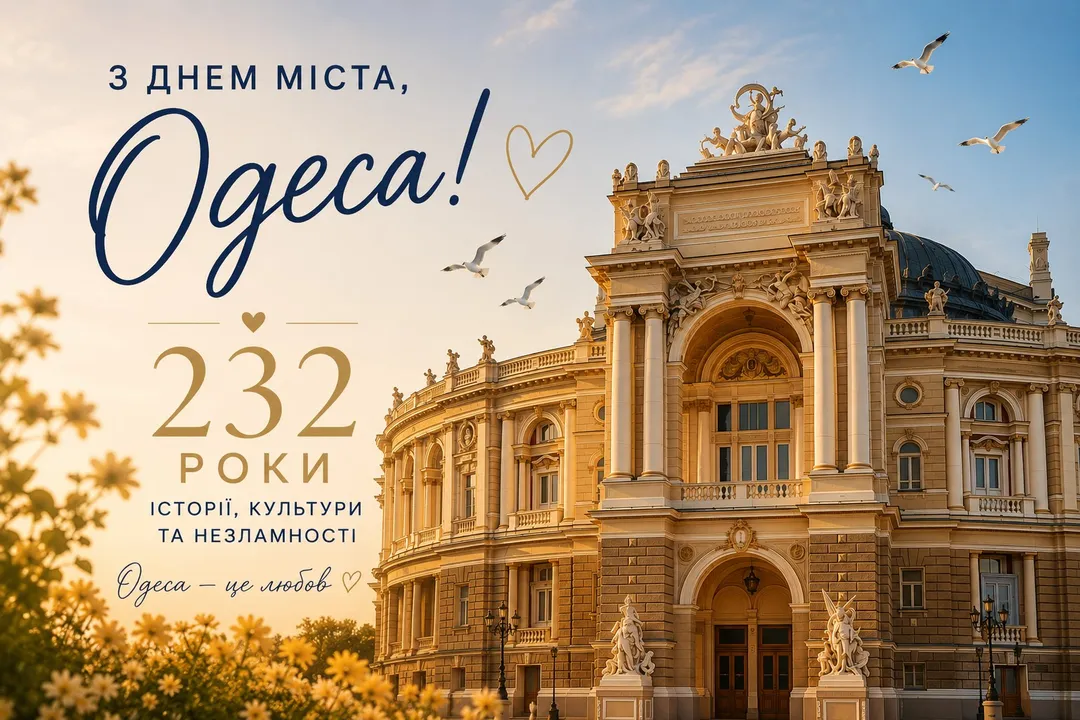
15. Odesa, Which Cannot Be Translated into Another Language
Odesa is not only the sea and the Primorsky Boulevard. It is courtyards, balconies, the Potemkin Stairs, the port, old apartments, bazaars, literature and a special urban humor.
The city formed at the crossroads of dozens of cultures, and this is visible literally in its architecture and cuisine. Odesa does not try to resemble another city. It has long ago developed its own intonation.
16. Lviv, Which Learned to Be Beautiful Without Stage Sets
Lviv is often photographed as if it were already a ready-made stage set: Rynok Square, stone townhouses, trams, cobblestones.
But the city's true value is not only its facades. It is courtyards, cafés, bookshops, churches, old workshops and dozens of cultural layers left behind by different communities.
Lviv does not need to be invented. It is enough to look at it closely.
17. Kharkiv Constructivism
Derzhprom became one of the symbols of Ukrainian architectural avant-garde of the 1920s. Kharkiv was then the capital of the Ukrainian SSR, and the city was literally being rebuilt for a new era.
Geometric forms, enormous volumes, functionality — the architecture looked as if it had been conceived a decade ahead. Ukrainian modernism was not a provincial copy of Europe. It created its own language.
18. Ukrainian Avant-Garde, Which the World Is Rediscovering
Oleksandra Exter, Alexander Archipenko, Kazimir Malevich, Sonia Delaunay — names that for decades were often presented without their Ukrainian context.
Kyiv, Odesa and Kharkiv were important art centers at the beginning of the 20th century. Artists, theater directors, designers and architects worked here, experimenting with form and color.
Ukrainian culture was not the periphery of the artistic process. It was one of its sources.
19. Heorhiy Narbut, Who Created the Visual Language of a State
Narbut worked with graphics, book design, typefaces, coats of arms and banknotes. His works became part of how the young Ukrainian state wanted to look.
His style is easy to recognize even a hundred years later: geometry, plant motifs, Ukrainian ornamentation and at the same time the European school of graphic art.
Narbut did not simply draw beautiful things. He created a system.
20. The Ukrainian Language, Which Has Not Frozen in a Textbook
Ukrainian has dozens of dialects, regional features, a long literary tradition, contemporary slang and words that change with each generation.
The Hutsul dialect does not sound the same as the Slobozhan one. The Polissian is not like the Odesan. And there is no problem in this. It is proof that the language is alive.
A language is not a museum exhibit. It changes together with its people.
21. Petrykivka Painting: Art That Is Easy to Recognize Without a Signature
Flowers, birds, berries, fantastic plants — the compositions of Petrykivka painting can be recognized even when the word "Ukraine" is removed from the caption.
Petrykivka painting is inscribed on UNESCO's Representative List of the Intangible Cultural Heritage of Humanity.
Its strength lies precisely in the details: the fine brush, the characteristic stroke that cannot be reproduced in a factory way.
22. Kosiv Ceramics — When a Limitation Becomes a Style
Kosiv ceramics is the technique of sgraffito, where the pattern is scratched into white slip and then filled with color. The palette is limited to three pigments, and this limitation has sustained the style for two hundred years.
Both crafts are alive: in Petrykivka and Kosiv, masters still work who learned at home rather than in an academy.
23. The Shirt That Was Read Like a Biography
The vyshyvanka is not a national costume but a system. From its cut, ornament and color one could once determine the region, village, status, age and marital status of the person wearing it.
Borshchiv shirts of Ternopil region were embroidered in dense black, so that the fabric is almost invisible. Polissian embroidery is strict geometry in red on white. Bukovynian — beads, silk, metal thread. Hutsul — a dense-stitch pattern in tight rows. These are not variations of one motif, but different languages that happened to end up within one country.
24. The Pysanka Is a Calendar, Not a Souvenir
Decorating an egg with wax in a step-by-step dyeing process is a technique older than Christianity, which later incorporated it. Every symbol had meaning: the forty sharp points, the endless line, the pine sprig, the little curl.
Ornaments were passed down the female line and kept within the village so strictly that a specialist can determine the origin of a pysanka down to the district.
In Kolomyia a museum in the shape of a pysanka, four stories high, was built for this. It looks eccentric and works flawlessly.
25. Kharkiv Photography and What Came After It
In the late 1960s the group "Chas" (Time) emerged in Kharkiv — photographers who deliberately worked against official aesthetics. From this milieu came Boris Mikhailov, laureate of the 2000 Hasselblad Award, one of the most prestigious in world photography; his works are in the collections of Tate and MoMA.
The Kharkiv school turned out to be the most influential contribution of the region to 20th-century world photography — and this despite the fact that its authors worked without materials, without publications, and at the risk of trouble for the very act of doing it.
The contemporary scene grows from the same root: institutions, prizes, Ukrainian artists in the main programs of the Venice Biennale. This is no longer folklore and no longer an archive.
26. The Donetsk Slag Heaps — Mountains Made by People
Slag heaps are artificial mounds of waste rock left after coal mining. Over the decades they have become an integral part of the Donetsk landscape. Some of them reach tens and more than a hundred meters in height, and inside some of them burning processes still continue because of residual coal.
Over time, grass and trees appear on the black slopes. In this way industrial dumps gradually turn into part of the natural landscape of Donetsk.
27. The Carol That Conquered the World
Mykola Leontovych worked on arranging an old folk carol for almost twenty years — he rewrote it several times, searching for its form. The melody at its base consists of four notes that repeat; the whole magic lies in the polyphony he built upon them.
The first public performance took place in December 1916 by the choir of Kyiv University. Then came 1919: the Ukrainian Republican Capella under the direction of Oleksandr Koshetz set out on a major European tour, which was at once a cultural and diplomatic mission of the young state. On October 5, 1922, the Capella performed at Carnegie Hall in New York. The audience was struck precisely by "Shchedryk".
In 1936 the American conductor of Ukrainian origin Peter Wilhousky wrote an English text to this melody — and so "Carol of the Bells" was born. Today it is sung every December all over the planet, it sounds in dozens of films and advertisements, and almost none of those who hum along know where it comes from.
Leontovych himself was murdered by a Cheka agent in January 1921, in his father's house. He was forty-four.
28. The Bandura — An Instrument for Which People Were Persecuted
Over sixty strings, an asymmetrical body, a playing technique with no analogues: the right hand on the treble strings, the left on the basses. The academic bandura of the 20th century is in effect a new instrument, made from a folk one.
Kobzars and lirnyks were an itinerant system for transmitting oral tradition: dumy, historical songs, news. The craft had its own guilds, its own secret language and rules of apprenticeship. In the 1930s Soviet authorities methodically destroyed this tradition — performers were repressed, and the repertoire was rewritten to suit official needs.
The fact that the bandura today sounds not only in philharmonic halls but also in clubs, combined with electronics and in bands that tour the world, is the result of a long and not very noticeable revival.
29. Music People Listen to Without Explanations
DakhaBrakha tours with its own definition of genre and fills halls from Australia to California. Onuka built the sopilka and bugay into electronica so that it sounds contemporary rather than ethnographic. Go_A brought the song "Shum" to Eurovision 2021 and placed fifth. Kalush Orchestra won the contest in 2022.
The academic scene is no less interesting: Valentin Silvestrov, who is past ninety, remains one of the composers whose music is most often performed in Europe among living classics.
What these musicians share is that none of them explains to the world where they come from. They simply play.
30. Borscht, Which Has No Correct Recipe
In 2022 UNESCO inscribed the culture of preparing Ukrainian borscht on the List of Intangible Cultural Heritage in Need of Urgent Safeguarding.
The wording is precise: what is protected is not the dish but the culture of its preparation. Because borscht is not a recipe but a method, in which every region and every family does it in its own way. Poltava-style — with galushky dumplings and goose. Green — with sorrel, spring, an entirely different dish under the same name. In the South — with carp. Somewhere with beans, somewhere with dried pears, somewhere with pampushky buns, somewhere without. The question of the "correct" recipe makes no sense in this system — and it is precisely this that keeps it alive.
31. A Cuisine in Which Geography Can Be Heard
Banosh is a Hutsul dish made of corn grits cooked in sour cream, with brynza and cracklings. It cannot be made quickly: one must stir in a single direction until oil rises to the surface. This is the cuisine of the mountains, where wheat does not grow on the high pastures, but sheep do.
Deruny — Polissia and potatoes, which over a couple of centuries became the main crop here. Kruchenyky, Crimean Tatar sarma, Bessarabian placinda, Transcarpathian bograch, Odesa flounder — all of this within the borders of one country.
And bread. Palianytsia, knysh, kalach, korovai — the shape of the bread here carried meaning, because each was tied to a specific occasion. The wedding korovai was baked according to rules stricter than any culinary standard.
32. "I Didn't Know a Ukrainian Had Done This"
Two stories out of many.
Ivan Puluj, a physicist from Ternopil region, in the 1880s designed a vacuum tube of his own construction and with its help obtained images of the internal structure of the body — some of the best of their time. He worked in Prague and Vienna, published, but did not win the patent and publication race: the discovery went to Röntgen, who published the result in 1895. Puluj later acknowledged this himself, stressing that these were parallel investigations — and physics of that time did indeed approach this threshold from several sides at once.
Yuriy Kondratyuk — in fact Oleksandr Shargei, who lived his entire adult life under a false name in order to survive. In 1929 he published at his own expense the brochure "Conquest of Interplanetary Space", in which he described a scheme for flying to the Moon: the spacecraft enters lunar orbit, a landing module separates from it, and then it docks again. Over thirty years later, the Apollo missions flew precisely according to such a scheme — NASA engineers who promoted this option cited, among other things, his calculations. Kondratyuk himself died at the front in 1942, never learning of this.
33. Thirty-Five World Records by One Person
Serhiy Bubka set thirty-five world records in pole vault — seventeen outdoors and eighteen indoors. He was the first to clear six meters, and his indoor record stood for twenty-one years.
Alongside him: Yana Klochkova — four Olympic gold medals in swimming, two of them in the most demanding discipline, the individual medley. Andriy Shevchenko — the 2004 Ballon d'Or. The Klitschko brothers, who changed perceptions of heavyweight boxing. Olha Kharlan, whose sabre medals are now counted in the dozens. Oksana Baiul, who won the 1994 Olympics at sixteen.
The list is longer than it seems. But the number thirty-five fit into it quite conveniently.
34. A List That Never Closes
The hardest part of such a piece is not finding thirty-five reasons, but stopping at thirty-five. Left outside the text are Kamianets-Podilskyi, standing on a rocky island; Sofiivka in Uman; Tustan; Trypillian ceramics, older than the Egyptian pyramids; Scythian gold; the Odesa Film Studio; bookshops where people come for a book at ten in the evening; Vernadsky and the academy he headed in 1918; Amosov; Prymachenko; hundreds of craftsmen whose names are known only in their own villages, and thousands of people whose work this week kept something important from falling.
Here simple arithmetic applies: the more attentively you look, the longer the list becomes. This is, in fact, the most accurate description of this country — it does not fit into any frame that is made for it, including this one.
35. Ukraine, Which Cannot Be Fitted into One List
We are used to talking about ourselves either too grandly or too skeptically. Both modes work equally poorly, because neither requires details. And here details are better than generalizations: a specific melody, a specific shirt from a specific village, a specific plate of borscht that no one cooks exactly the same way, a specific person who went to work this morning although had every reason not to.
Thirty-five reasons is simply a convenient number for a headline. The real reason is one, and it cannot be formulated as a list: all of this exists alongside you while you read this text. The dunes move, the beeches grow, the slag heaps smolder, and someone in Kosiv is scratching a pattern onto white slip right now.
The country does not need to be loved beautifully. It is enough to notice.
Also read: Mykola Leontovych: How “Shchedryk” Became Carol of the Bells and a Global Hit
Text: Arina Blyzniuk
Comments
No comments yet — be the first.
Discuss on Telegram